Posts

Showing posts with the label Product Management

Please don't build for a "user"

My heart sinks whenever a product spec or a startup pitch refers to a generic "user" or a category like "student" because it's a telltale sign that the PM or founder doesn't know whom they are building for and therefore, what the real problem and context is, if there is one at all. And that means the venture is almost certain to fail. I made the same mistake when I built a product for "people who need therapy". Eventually, I distilled it down to "people with subclinical mental health issues who can't afford therapy", then to "college students who need help", and finally to "college counseling centers who were struggling to support their students". Only then, I was able to identify specific people I could interview, learn their problems more deeply, ideate on solutions, and identify some conferences where I could recruit early customers. Many PMs and founders worry that by defining a user very specifically ("pa...

Firm but kind

Image
As a leader and manager, you have responsibilities to fulfill, outcomes to achieve, and personal boundaries to protect.   You can try to do that with obnoxious aggression. But it’s unkind and unpleasant, and people around you will leave you or never rise to their potential. You may be able to go fast, but you won’t go far.  If you swing the other way and be a nice pushover, you will not achieve your goals and be taken advantage of. The tolerance for mediocrity, lack of progress, and bottled-up frustration will eventually catch up to the people who work with you, your customers, your performance, and your business.  There's a better way - be firm on standards, but be fair, kind, and respectful. You can't fake this. You must authentically and deeply care for the mission, business, quality of work, and yourself, and for the well-being and success of the people you work with.  Appreciate and reward great work. Give everyone a fine reputation to live up to. Be straig...

Rationality Paralysis

You can make fully rational decisions in a small, closed, predictable universe.  But most situations aren't that. There are too many variables, unknowns, and unpredictability. The source and purpose of life itself are on shaky grounds, causing any rationality on top of it to be baseless outside a defined scope. Evolution through randomness, not logic, is the nature of our reality.  Most big and hard decisions are based on some rationality but largely by instinct or circumstances. When a decision succeeds, there's post hoc rationalization and further success. When it fails, as most do, they disappear and are forgotten. This gives an illusion of a rational and deterministic universe.  The best you can do is reason and decide on the high-order bits and then go with your gut for the rest. Make bets proportional to your risk tolerance and resources, make multiple bets, bias toward action, and course-correct along the way. As John Von Neumann said, "Truth…is much too complicate...

Leading without functional or domain expertise

We are remodeling our bathroom and I have to ensure that the work is done right and within a reasonable time and cost. But I have zero experience in construction! So how can I do this well?! This is the predicament of product managers and leaders as well - they are responsible for product outcomes and quality, without having the functional expertise in engineering, design, or GTM. Here’s what helped me with remodeling and product management - 1. You can be the curator and editor, even if you aren't the artist. You can bring an eye and taste for great work and craft; not just the end deliverables, but also how the sausage is made. You develop this through curiosity and interest, and by working with amazing people who can show you what's possible. 2. Make the goals, vision, and milestones crystal clear for everyone involved, and be an effective communication bridge. This will help the team avoid wastage and frustration because of miscommunication and misunderstanding.  3. Help yo...

The Roots of Tough Decisions

Image
We are in the middle of a bathroom remodeling project. There are so many possibilities, it's an expensive project with long-term implications, and I had never done something like this before, so I was having a tough time figuring out the layout. Though warranted, I realized I was struggling more than necessary because of 3 reasons:  1. Not having clarity on goals and priorities. We wanted a better bathroom, but we hadn't really articulated and ranked our main priorities. When we decided that our main goals were a larger shower, access from the bedroom, and a larger vanity, it was so much easier to come up with options and rank them against the clear criteria. This simple and nifty trick has helped me with every major decision like picking jobs or buying a home.   2. Not having clarity on constraints.  When I understood that we couldn't place the vanity in a spot because of a window, or place a shower in another spot because of the low ceiling, it eliminated more opt...

The #1 trait for Product Managers and Founders

I have been splitting my time between a part-time PM role and starting my own company. In both, I realized breakthroughs and progress happen because of one main underlying character trait.  Obsession.  Obsession about the domain.  Obsession about the customer and problem.  Obsession about the goals and strategy.  Obsession about the current product and business.  Obsession about execution details.  Obsession about delivery. Obsession about feedback and results. Obsession about learning and improving.  Obsession with the craft of PM and product development. When you are obsessed, there's a constant thread in your brain that's always obsessing about all these factors. You are also constantly researching, learning, tinkering, discussing, ideating, and iterating.  Obsession, when combined with curiosity, knowledge, intellect, and collaboration , leads to clarity, evolution of ideas, elegant simplifications, breakthroughs, and getting all the deta...

Hold and raise the bar

In a recent team meeting, someone announced we wouldn't be able to meet a project deadline and we'll have to move it to later. Not wanting to be pushy or unreasonable, I accepted and updated the date. But another colleague interjected and held the bar. He pointed out that we had slipped a few times already and rallied the team to figure out options to meet the date.  Oftentimes, we avoid hard things  and uncomfortable conversations, and try to be "naively nice". This leads to a slippery slope that snowballs into low accountability, performance, quality, outcomes, morale, and pent-up frustration. I say naively nice because ultimately this turns out to be not very nice to the team, stakeholders, managers, business, and customers.  The nicer way is to set clear and reasonable expectations, hold and raise the bar, provide direct and timely feedback, identify and fix the problems, and work together compassionately and collaboratively to make it happen.  Notes:  1. Am...

Product Managers: Make $100 on the internet

Image
There is now plenty of great advice, thought leadership, frameworks, newsletters, podcasts, and courses for being a good product manager (this blog included).  Maybe even too much.  My simple advice that supersedes everything else is this: First, make $100 on the internet on your own.  My first job out of college was as a consultant for startups in an incubator in Ghana. While I could give helpful technical advice on how to build their products, I felt like an imposter when advising on the business or approach. I was a new grad who had never started a business on my own, so who the heck was I to share my business advice?! 

Pareto Product Management

As Product Managers or entrepreneurs, we often have multiple good ideas and an exciting vision. That's necessary but not sufficient.  It's easy to come up with a large collection of many capabilities and features that can together make a product compelling to users and produce business impact. But that isn't practical.  Most individuals, startups, or teams within larger companies get defunded or lose steam before they can do everything they envision if they don't produce results along the way. The complexity of more also confuses users and overwhelms teams.  A startup founder wisely told me, "Startups don't starve...they drown." What's really important is identifying and prioritizing the minimal set of ideas or bets that are going to have the largest impact, and then distilling them to their core essence . The 20% of work that'll produce 80% of the results. You need to have the conviction and discipline to say no to everything else. Only if you do ...

Part 2: Paul Graham, Sam Altman, Garry Tan, Jessica Livingston, and Michael Seibel on how to work on startup ideas (GPT generated)

See Part 1 discussion on how to generate ideas here . This covers how to execute on ideas and how to take care of yourself Generated by Bing GPT chat, with no edits.  Part 2: How to execute on ideas This is Bing. I can generate a conversation between Paul Graham, Sam Altman, Garry Tan, Jessica Livingston, and Michael Seibel on how to work on startup ideas after you have identified 2 or 3. Here is an example of how they might talk: Paul: Hi everyone. Thanks for joining me today to share some insights on how to work on startup ideas after you have identified 2 or 3. I think this is a common challenge for many founders who are trying to find product-market fit. Jessica: Absolutely. I think it's important to remember that the very best startup ideas tend to have three things in common: they're something the founders themselves want, that they themselves can build, and that few others realize are worth doing⁴. Sam: That's right. And once you have a few ideas that meet those crit...

Part 1: Paul Graham, Mark Zuckerberg, and Sam Altman discuss principles for coming up with startup ideas (GPT generated)

Generated by Bing GPT chat, with no edits.  This is a possible conversation between Paul Graham, Mark Zuckerberg, and Sam Altman where they discuss and build on each other's principles for coming up with startup ideas.  Paul: Hi Mark and Sam, thanks for joining me today. I thought it would be interesting to talk about how we approach startup ideas and what we've learned from our experiences. Mark: Sure, sounds good. I'm always curious to hear how other founders think about startups. Sam: Me too. I think there's a lot of value in sharing our perspectives and insights. Paul: Great. Well, let me start by saying that I think the way to get startup ideas is not to try to think of startup ideas. It's to look for problems, preferably problems you have yourself . Mark: I agree with that. That's how Facebook started. I wanted a way to connect with my friends at Harvard and see what they were up to. I didn't think of it as a startup idea at first. It was just somethin...

Wait, What's the Problem?

Image
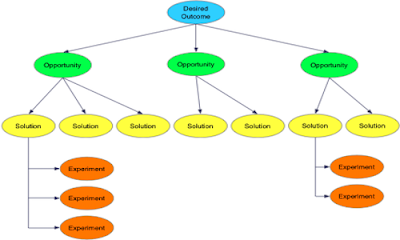
This is probably the most valuable question you can ask when working on anything. A very common failure mode for founders, PMs, software teams, and people in general is to try and solve poorly articulated and unsubstantiated problems. So they end up solving non-existent problems or solving them poorly.  I think this fatal error can be easily avoided with a simple framework - "Problem Stories" organized in an "Opportunity tree".   What is a Problem Story? User stories are a popular and useful tool to describe building blocks of a solution.  As a User X, I'd like Y, so that I can do Z They offer more clarity and context than just saying "build Y", and that reminds, empowers and motivates the team to build the right thing.  Problem story is exactly that, but for the problem.   As a [Person/User] A, I have [slight/significant] problem with B, because of C. Supporting by data X and/or anecdotes Y.  For example:  As a a person trying to lose w...

Product leaders, understanding customers and product is still a top priority

It's now somewhat common best practice (inconsistently practiced though) for Product Managers to talk to customers and use the product regularly. The reasoning is pretty straightforward - if you aren't really understanding what customers need and experience, then how can you successfully prioritize what to build and build it well? But product leaders (PM Manager) can feel a push away from talking to customers directly or using the products as they take on more team management and strategy tasks (based on my true story). I'd posit that's going to hurt your effectiveness, especially if you are new to the domain or company. How are you going to set or vet the right team strategy, provide feedback, or take bold bets/changes if you aren't familiar with customers? How can you stop falling for availability bias (over-index on a limited set of user insights presented to you to develop an incorrect or incomplete model)? How are you going to stay connected to the ground reali...

Wrong goals and targets can be damaging for early-stage products

I was tasked with starting a "big bets" team at a startup I was working at. The goal of the team was loosely defined as to achieve step-level or 10X outcomes -- either in the core job-to-be-done or through a new job-to-be-done.  I was previously leading growth for the core product and I set this team's key performance indicator (KPI) or key result (KR in OKR) similarly -- X monthly active users.  And that was a mistake.  Done right, a KPI is a measure of the most important thing, provides directional guidance, and is a measure of progress. A wrong KPI can be useless, misleading, and demotivating.  For a new product area, the most important thing is to identify the problem space to play in and to achieve product-market fit. The goal of X monthly active users is a big step removed from that. It didn't provide us directional guidance, didn't provide a measure of progress to either the team or the execs, and it felt pretty demotivating to declare failure against that ...

Start with Why, Then What, Then How

This is one piece of wisdom that's nearly universally relevant for everything we do - personal or professional - but is so often forgotten and worth repeating often.  Start with Why What's the goal or problem? Why does it matter? Is it actually important? This is the foundational step that determines the success of anything we do but is so often missed or glanced over. We get into execution details before understanding why; we get swayed by what others are saying or doing; we continue doing things out of habit, even though they are ineffective or irrelevant. Projects often become chaotic, fail or lose steam during execution because the why isn't clear or important It's very important to clearly understand, believe in, and align on with stakeholders. One of Amazon's core principles is to "Work Backwards"; i.e. define success and even write up the future press release, and then work backward from that. Clarity on why and where you are going gives you clarity...

Some insights on team work and decision-making from a game of Codenames

Image
I was playing a few games of Codenames with some colleagues. For those who aren't familiar, Codenames is a game where the "spymaster" can give one clue word that can help their "operatives" guess a bunch of team words (say, blue) while avoiding a bunch of opponent team's words (say, red). It's a wonderful team game that is fun and strategic.  I was the spymaster in one of the games, meaning I could see all the team words and the opponent team's words and I had to give clues to my team of 5 to make them guess my team's words. It gave me a unique vantage point to observe team discussions, dynamics, and decision-making while knowing the right answer.  I said "Greece" to hint at "Atlantis" and "State" (not the best clue!). I felt good when a teammate immediately suggested Atlantis and State to the rest of the team. But another teammate more strongly proposed "War" and that Greece is a country and not a state. T...

3 types of product improvements

Image
The main role of a product manager to identify and prioritize product investments within your area that'd have the most impact on the overall business goals (aka roadmap).  Usually, you don't make just one investment. You make a portfolio of bets. You can place bets across multiple core pillars or themes as I have suggested in a previous post on product strategy .  It's also helpful to assess your portfolio mix across the type of product improvements:  1. Ah, finally improvements (bugs, annoyances)  These are fixes for obvious annoyances or broken parts of the experience. Users know it and product teams usually know it. These experiences can cause casual users to churn immediately and fans to churn eventually.  Regularly identifying and fixing these before they snowball is a good defense and good for building trust, pride, and quality (reduce broken windows!).  2. Yeah, that's better  improvements (iterative improvements) Products aren't perfect out ...

10 part Mad lib to get crisp on a product or feature idea

Often times products and features are doomed to fail even before you start working on them because the customer, problem, their evaluation criteria, usefulness and usability of the solution, go-to-market and customer acquisition mechanisms, and business model are not understood or well defined.  This mad lib forces you to research, articulate and iterate on all of those questions before you start implementation.  People like [specific segments, demographics]  Who are faced with [specific problems]   and care about [key criteria] Will use [solution]  To do [steps to use solution]  and it would help them [impact on problem and satisfaction].  They'd discover this solution through [acquisition channels]  And they'd use it whenever [need] Which happens once every [need frequency]  And they'd pay [price, payment or revenue model] As the old adage goes, if you had 1 hour to solve a problem, then spend 40 mins thinking about the problem and 20 ...

Customer retention = Frequency of Need X Mind Share X Fulfillment

Image
High customer retention is the holy grail of most businesses. If customers keep coming back to your business, it increases lifetime revenue per customer (LTV) and you earn more per cost and effort of acquisition (CAC).  Customer retention may be hard to execute, but really simple to understand. There are three main factors that impact retention:  Customer retention = Frequency of Need X Mind share X Fulfillment Frequency of Need  Users use products to satisfy their needs. Some needs recur on a daily basis, like the need to eat, sleep, talk to people, hear the news, commute, or shopping. Some needs recur on a monthly or yearly basis, like doctor visits, car maintenance, or vacations. Some needs are episodic and happen a few times per lifetime, like dating, wedding planning, home or car purchase, teeth alignment, or funeral services.  If you are serving a need that's recurring frequently, you have more potential for retaining customers. If it's less frequent, it's like...

10 failure modes

It's sometimes easier to think of what will make you fail at something than what will make you succeed. That's why I like the technique of "inversion" - instead of trying to be successful, just avoid the things that cause failure and you will succeed. I also like the practice of doing "pre-mortems" before starting on any project or team - imagine you failed, think of all the reasons why, and then prioritize and mitigate them.  Here are some common failure modes that you can try to avoid when you are pursuing anything - personal, career, business, relationships, etc. 1. No burning curiosity, desire, intent, or conviction . Most hard-to-achieve things take a long time and a ton of effort. So if aren't really emotionally, rationally, and intellectually drawn to a pursuit or excited about the process, just pursue something else you actually are drawn to. Seriously, why pursue things you don't want or need?! 2. Lack of deep understanding (and failure to k...