

I hate to pile on to the already exhausting AI hype and fears. So I’ll try to keep this short, grounded, and practical.
I’m repeatedly surprised at how good Claude Opus is at product and strategic thinking. There have been a handful of instances now where I’ve been able to one-shot better product and design directions with Claude than what a Product Manager or Designer presented after many days of deliberation and meetings.
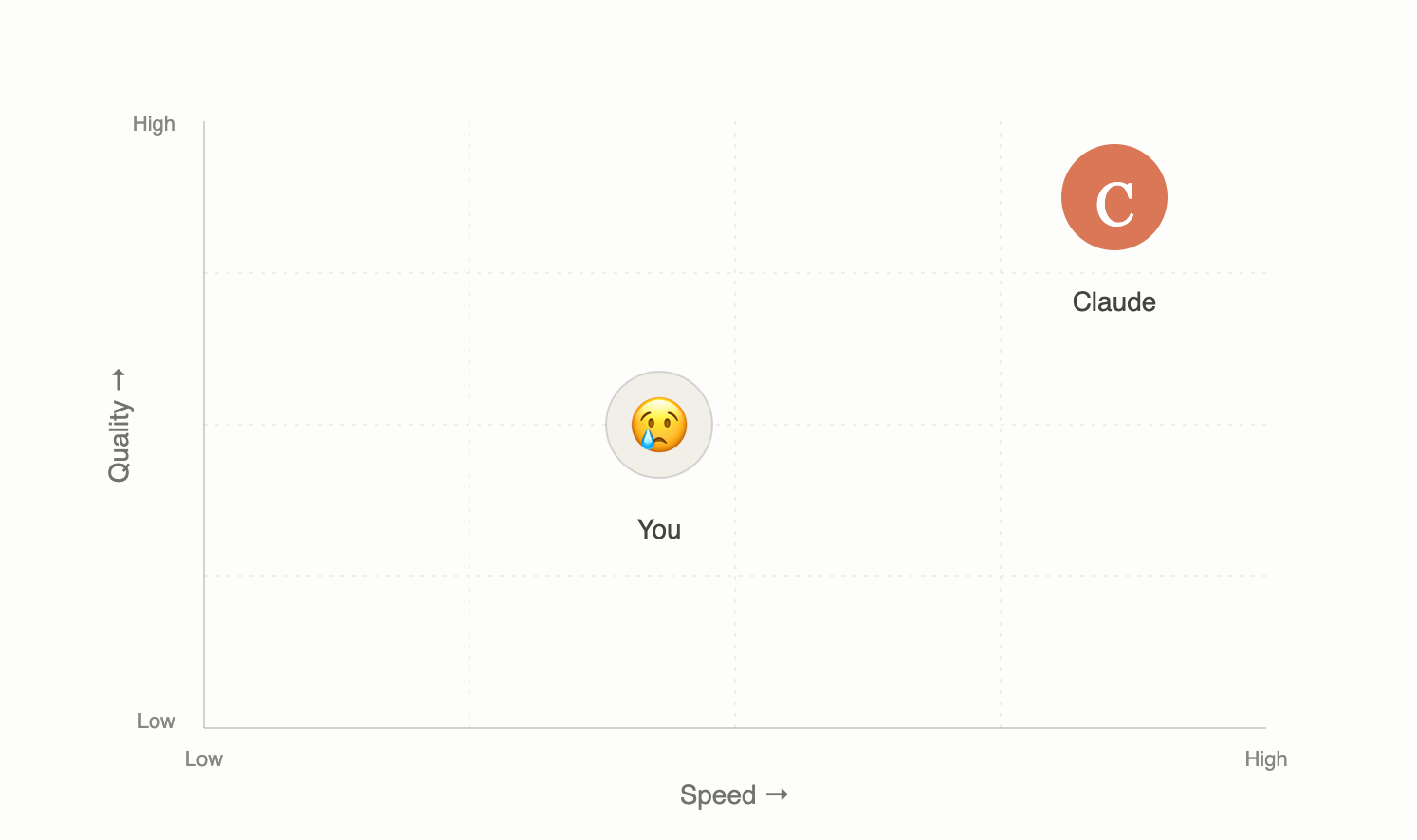
In one instance, Claude pointed out that the “enter promo code” text box in a checkout flow should be collapsed by default to avoid triggering FOMO for customers. In another, Claude walked through the nuanced needs of different customer segments and presented design options that optimized for all of them. In these instances, it was also better and faster than me at critiquing and generating options. I expect this will only get more common as models, harnesses, and AI-use tactics improve.
The minimum bar for PM and designer output is now at least what AI can produce in one shot. And on average, your output needs to be significantly better to justify the human investment.
It’s hard to compete against AI on breadth, recall, speed, and cost. We will soon be in a very uncomfortable situation where AI can produce better product and design output than human PMs, designers, and managers, at a tiny fraction of the time and overhead. Some capable people will leverage AI to do the work of many, and do it better.
If we want to continue and thrive in our PM, Design, or tech careers, we have no choice but to become one of those people. I have gathered 4 ways to do that:
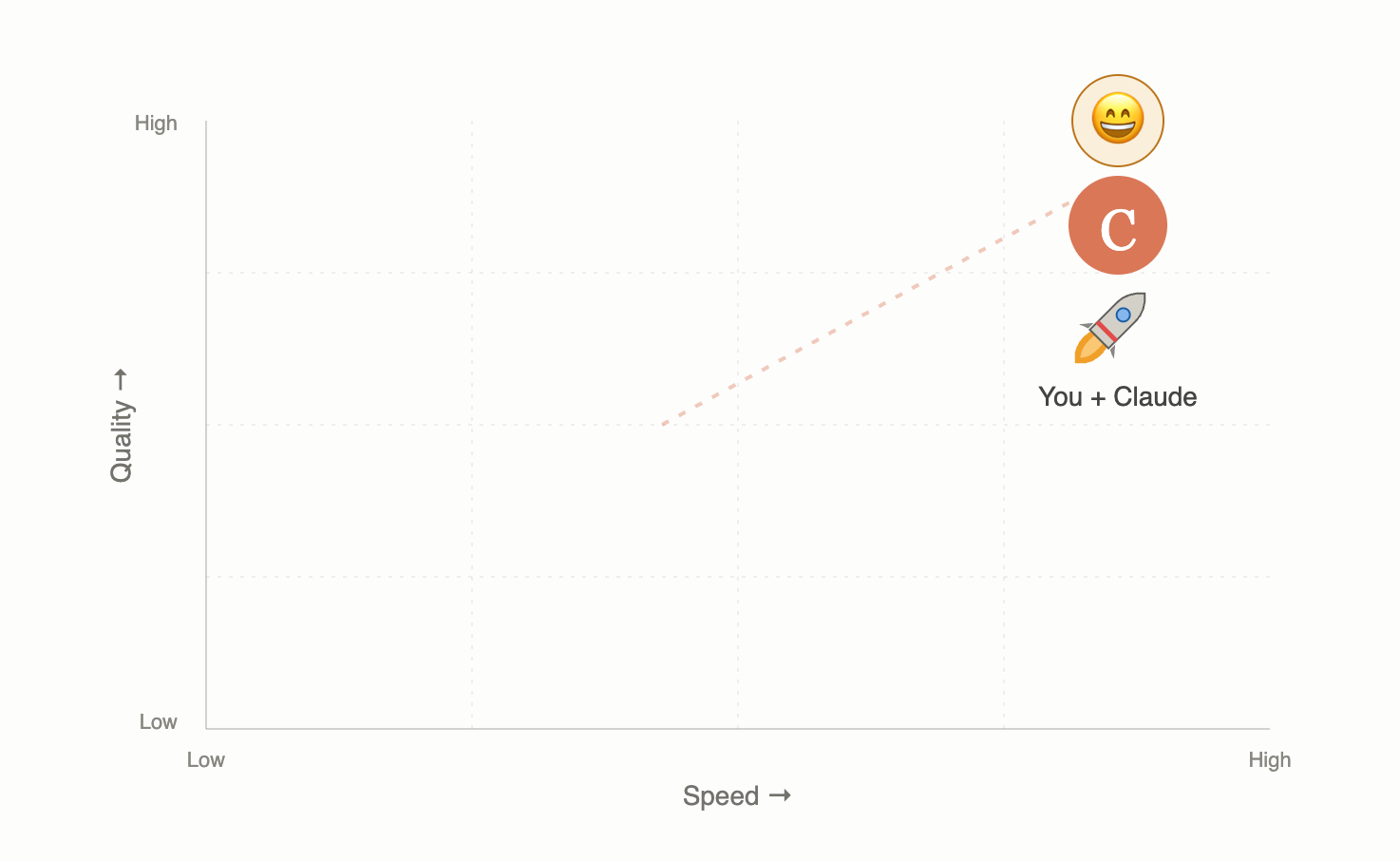
First, you need to consult with AI at the 10% and 90% stages of your work. That helps you explore a breadth of considerations early, and refine your drafts. Hopefully, just this “reflexive AI use” (as the CEO of Shopify frames it) will place your work at or above the AI bar.
Then, you need to get better at using AI. The first place to start is with better prompts and context. You need to frame your question clearly - what is the situation, what do you know, what are you trying to achieve, what are the challenges and constraints, what’s working and not working, what are your thoughts, etc. You need to iterate on the answer, go deeper and broader on various aspects. I’ve seen PMs build multiple folders of context about their product - strategy docs, help center articles, metrics, screenshots, user segments, interview notes, prototypes - and have the AI keep that context updated. Some have connected the AI to their product GitHub repo and analytics to ground brainstorming and answers in code and real data. These tactics are working well, and make your output better than a vanilla prompt.
Then, you need to go beyond improving your current ways of working and figure out how to work differently. This might be a good time to step back and think about what your role really is (~ keep your business growing and winning with great products, GTM, strategy, and culture), and how you can deliver on that in this new world. For example, one PM on my team is generating prototypes, producing demo videos on top of them, getting async customer feedback, and brings only validated proposals with prototypes to the team — all within days. Some others are shipping bug fixes and small features. Most PMs can lean more into areas like cross-functional leadership, customer engagement, and GTM and act like GMs and business leads. That’s a real shift in how PMs work, and it lifts the output quality of the whole team.
Lastly, and importantly: as you use more AI, please don’t propagate AI slop. Don’t subject your teams and customers to entirely AI-generated docs and artifacts that are generic, bloated, littered with inaccuracies, and disconnected from reality. Regardless of what everyone says, AI is useful but nowhere close to autonomously good. When used well, it can be 80% good and still 20% slop. You need to be a discerning guide and editor, not a passive receiver.
Use AI to push your thinking. But let the final thoughts and outputs be yours, and express them in the simplest, most accurate way possible.
Notes:
* I’m speaking specifically about Product Managers here, but I think this applies generally to most knowledge work.
love this! great points!!