

What shapes the way we think and act? Why do some people spiral while others rise? What actually directs the arc of a life?
For a long time, I didn’t have a satisfying answer. Then I realized the explanation had been sitting inside an odd little memory from high school in Chennai.
MAX
In grade 10, my family visited a huge book fair. The place was packed: people, stalls, noise. A crowd had formed around a stage with a sign that read MAX, short for Madras Academy for Excellence.
On stage, a group of national memory record-holders were doing impossible things. They memorized fifty random words in minutes and recalled them in any order. This was catnip to my nerdy brain. I volunteered. They taught me their technique. I tried it. Ten minutes later, I was on stage, reciting an entire audience-generated list flawlessly. Forward. Backward. By number.
I signed up for their full “Student Success” program. They taught goal-setting, focus, discipline, speed reading, memory, meditation, creativity, communication. Actual life skills, the kind schools never bother with. A lot of it stayed with me for years.
But one technique stuck with me for a very different reason. Because it felt ridiculous.
Self-hypnosis
The technique was called self-hypnosis. You had to stand in front of a mirror, stare into your own eyes without blinking, and repeat an affirmation three times. You did it as soon as you woke up, again in the afternoon, and again before going to bed.
The script was formulaic.
I will <goal>!
I have the ability to do it!
I can do it, I can!
It felt silly. Slightly embarrassing. But I did it anyway.
I decided my goal would be to top my school in the national grade 10 exam. Honestly, it was a stretch. I was usually in the top 5 or 10, not the absolute top. Still, three times a day I stood in front of the mirror and said the line. I even mocked up a fake scorecard and kept looking at it.
Then the results came. I scored 98 percent. I ranked second in my school and sixth in the entire country. And to be clear, there was nothing in my pre-board performance that hinted at this. In one course, Hindi, I was barely holding things together.
I was thrilled. But confused. Did the mirror routine do something? The rational part of me rejected the idea. But the lived experience was too strong to ignore.
Years later, the puzzle clicked into place in an unexpected area: artificial intelligence.
The real insight
If you have played with ChatGPT, you know this effect. You say something like You are X. You behave like Y. And instantly the model shifts into that identity.
New prompt. New behavior.
Different prompt. Different path.
No mysticism. Just the system responding to inputs.
At some point it struck me that this is also how our minds work.
Our brains are biological models. Every stimulus we consume becomes training data. Every input triggers a pathway. Every pathway produces thoughts, emotions, intentions and actions.
And the self-hypnosis? It was not magic. It was not manifestation. It was not cosmic energy.
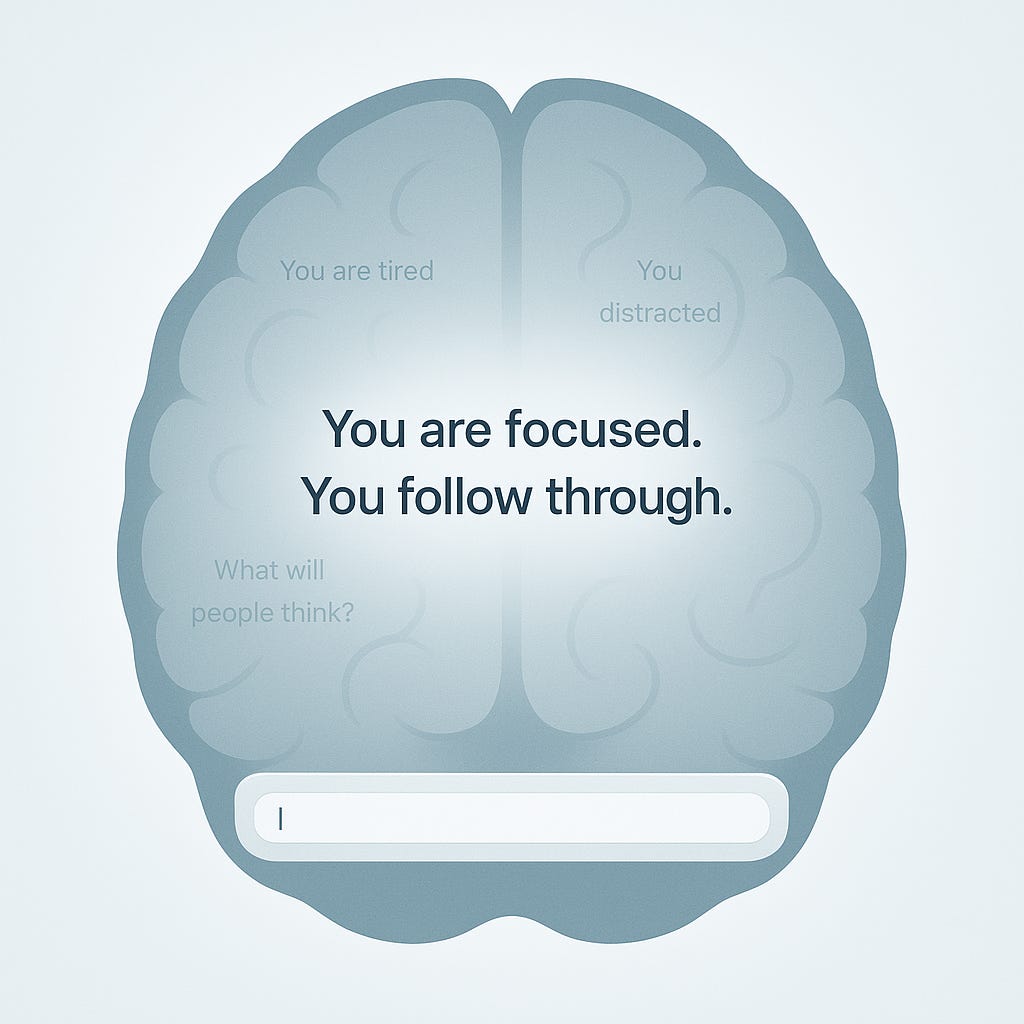
I was prompting myself.
Three times a day I was feeding my internal model a consistent identity-level instruction: You are someone who tops the school. That prompt shifted my subconscious, my attention, my effort, my emotional state and the way I interpreted setbacks. The model kept taking the path that matched the prompt.
The result looked dramatic on the outside. Inside, it was just stacked micro behaviors driven by a repeated identity cue and goal.
The hidden problem
Most of the time, we are not doing this intentionally. We let random stimuli prompt us. Notifications, social media, news, negativity, comparisons, memories and people who drain us. This creates mental drift. Drift turns into loops. Loops turn into identity.
If you feel overwhelmed or anxious or unfocused, it is often because your mind is running on low-quality prompts that you did not choose.
Sleep, silence and nature help because they collapse the noise. They act like clearing the context window. Psychedelics and cannabis quiet the Default Mode Network, the part of the brain that keeps replaying old prompts. Once the noise settles, your internal system can respond cleanly again.
But clearing alone is not enough. The real game is the prompts you choose afterward.
Curate your inputs
You can shape your mind the same way you shape an LLM.
Choose what you feed it.
Choose who speaks into it.
Choose the ideas and behaviors that get repeated.
Choose the identity and values you reinforce.
This includes your environment, your friends, your information diet, the tone of your own self-talk, and your actions. Buddhism’s Eight-Fold Path is essentially a prompt filter. It teaches you to avoid the three poisons of attachment, aversion and delusion because they generate destructive mental loops.
On the flipside, positive inputs matter. Journaling, gratitude, mindfulness, self-hypnosis, vision boards, loving-kindness, quiet time in nature, and uplifting people. These become identity-level prompts that shift your internal trajectories.
The real takeaway
Once you see your mind as a model, everything becomes clear.
You are always being trained.
You are always being prompted.
You are always running the last set of instructions you allowed in.
The only real question is whether you choose the prompts or let the world choose them for you.
If a single sentence can change the entire behavior of an AI, imagine what decades of repeated, unexamined prompts are doing to you.
Choose your prompts with intention.
Engineer the inner model.
Your outputs will follow.