

Why do you like certain people or music instantly — and not others?
You didn’t do a structured analysis.
You didn’t make a pros-and-cons list.
Something just clicked. And that was that.
The same goes for cities, coffee shops, relationships, products, and even presidents. Why Brad Pitt over Chris Evans? Why Tokyo over Paris? Toyota or Mercedes? Claude or ChatGPT? Why does one place feel like home and another feel… off?
When I asked a sales lead what makes us win or lose a customer, I expected to hear about features, pricing, or buyer personas. But he shrugged and said, “Honestly, it mostly comes down to whether product managers or execs are on the call.”
There’s a pattern here. And it isn’t logic.
Most of us pretend we live like Spock.
But in reality, we perceive and decide like jazz musicians - improvisational, intuitive, all feeling. From friends to lovers, brands to beliefs, the throughline in our choices isn’t reason.
It’s resonance.
It’s mostly vibes.
What Vibes Really Are
We can’t deny the existence and importance of vibes, but their inner workings still seem like woo. Lately, though, as I’ve been learning about large language models (LLMs), I have a theory.
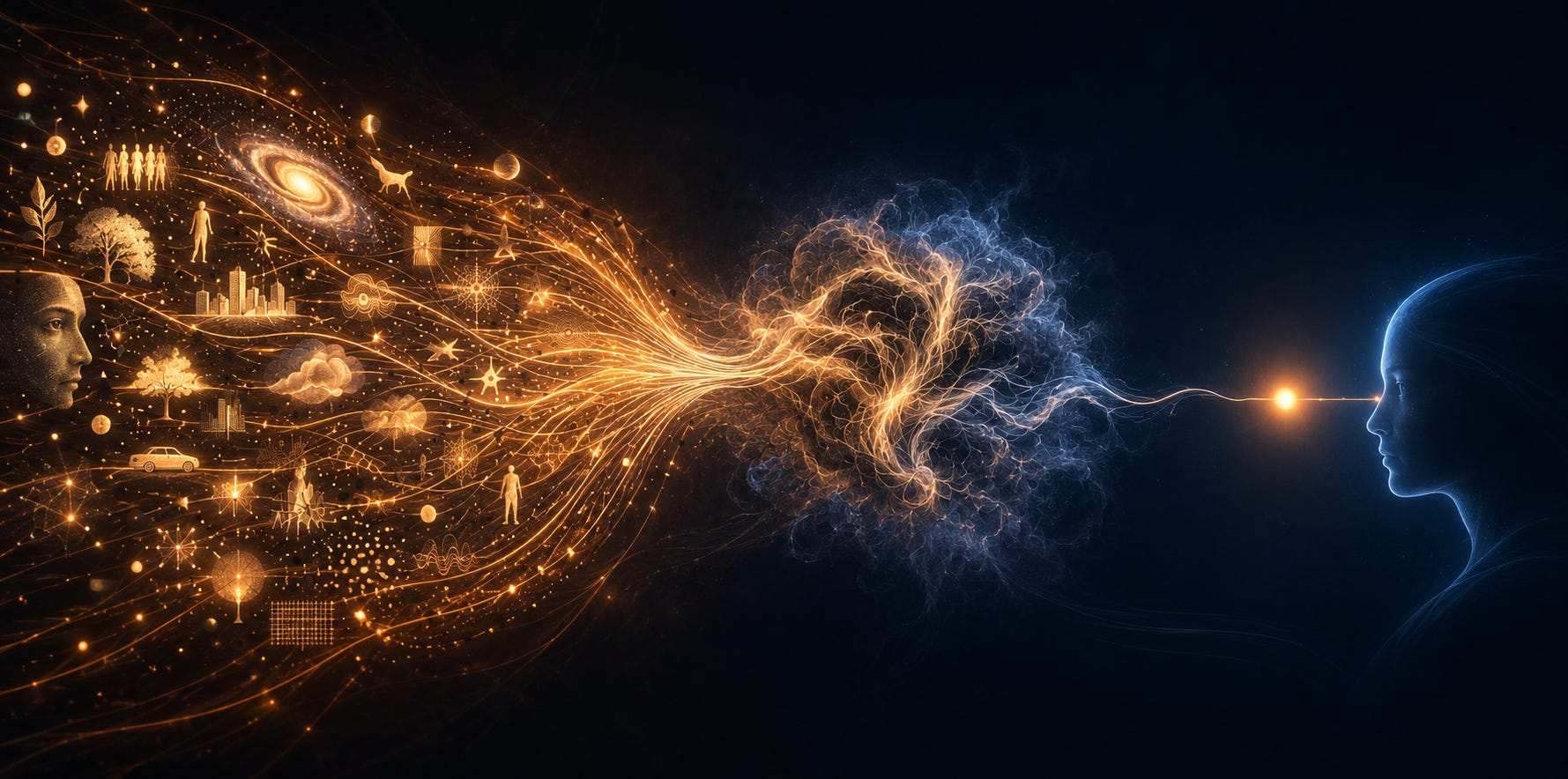
An LLM doesn’t “understand” words the way we think about understanding. It never learns a definition of a word. Instead, it learns how the word behaves — what tends to appear around it, what emotions, topics, and contexts it travels with. Over time, each word becomes a location in a massive multidimensional space of relationships. Words that feel similar end up close together. Words that rarely appear together end up far apart.
Meaning and predictions don’t come from explicit rules. They emerge from geometry and invisible patterns.
Human perception works the same way.
Everything in the universe is infinitely multi-dimensional. Most of these dimensions and their values are opaque to you...the conscious mind. You don’t perceive raw light or sound. You don’t track every sensory input in their base energy form. You see objects. You hear words. Your brain transforms the complexity into something coherent.
Consciousness is a low-resolution rendering of something far richer underneath.
Beneath awareness, our subconscious is processing an impossible volume of signals — posture, tone, micro-expressions, memory, pattern, danger, familiarity — and performing millions of matrix multiplications every second to assess: Is this good? Safe? Worth it? Real?
The final compressed result of all the computation reaches your awareness as single feeling:
a vibe.
Vibes aren’t irrational. They’re pre-rational. An ambient sense of rightness or wrongness that attaches to people, places, brands, choices, aesthetics.
Vibing
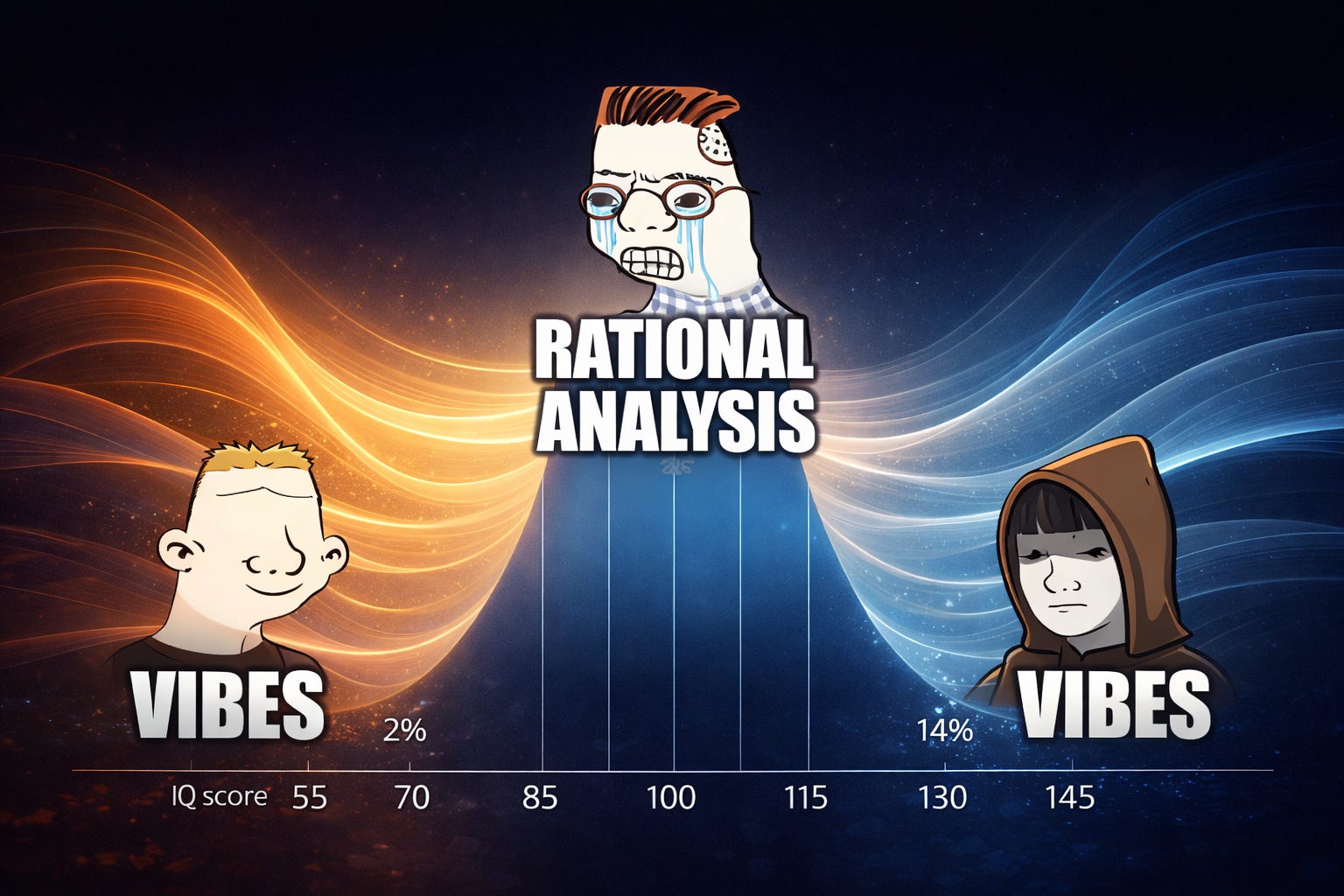
We live in a reality too complex to fully explain, too layered to decode logically. Our minds can’t track every input. But it appears like our subconscious can do better.
For the overly rational and left-brained amongst us, vibes is a balancing world view and epistemology.
Vibes aren’t perfect. They’re shaped by our biases, traumas, upbringing, culture, and evolution. They may be exaggerated or plain wrong. What feels “off” to you might simply be unfamiliar. Since vibes control behavior, there’s incentive for people to “hack vibes”. Which is why your conscious mind still matters to fact-check and override vibes.
Embodying your own authentic vibe is just as consequential as perceiving others’. Not everyone will like your vibe, but your people will find you.
You are a vibing being,
in a vibing universe.
Tune in.
I read the book called “Why Buddhism is true” by Robert Wright yesterday. It talks about this, among other things, from the perspective of evolutionary psychology (the author’s background) and modern research into how the brain works. I think you might like it, check it out if you get a chance, cheers!
Very true. Nice thoughts