

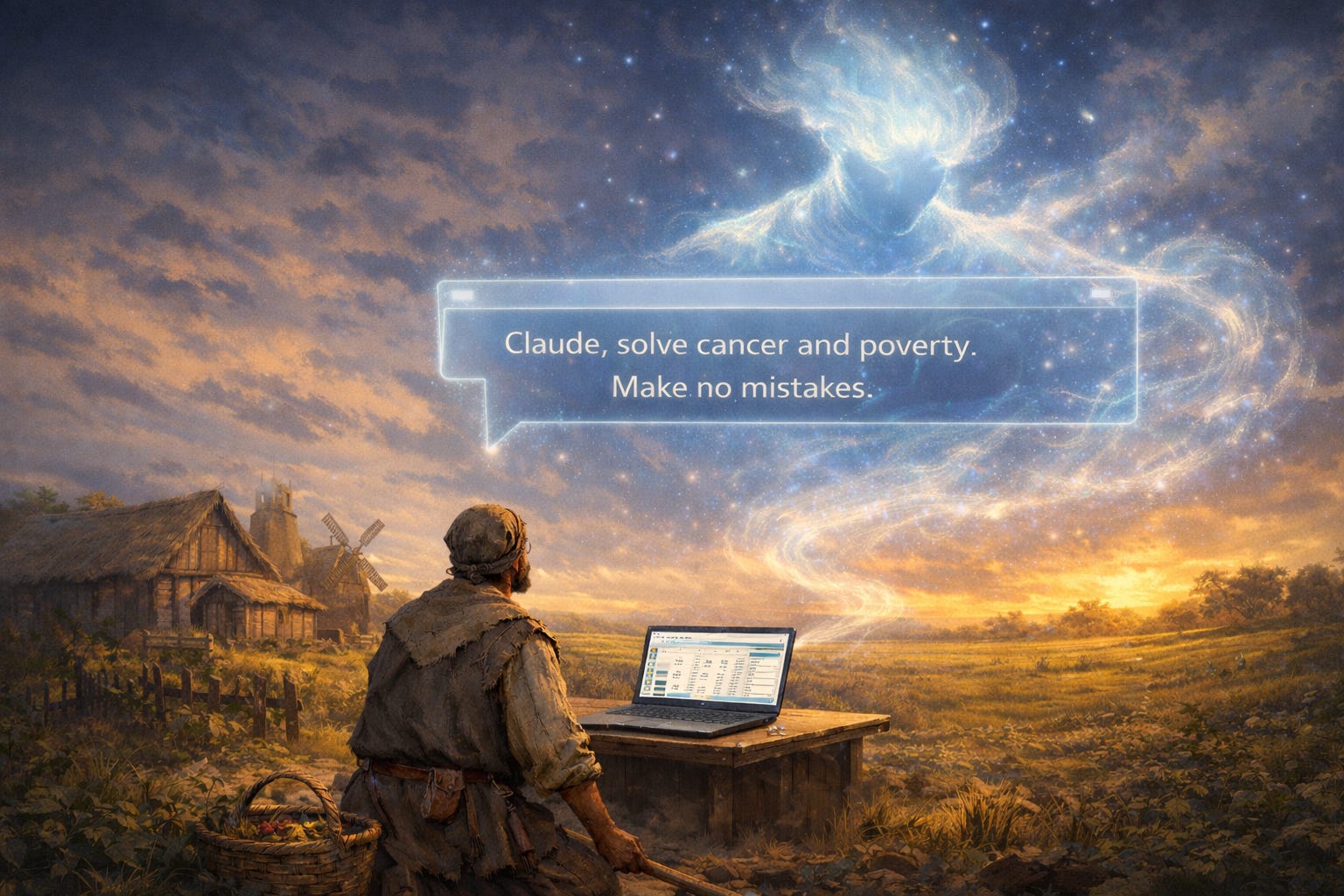
This meme prompt is funny because it is absurd; in two ways.
First, the idea that Claude can actually solve cancer and poverty; even the most AI-pilled priests in the church of Dario would admit we are still a few years away from this being a reality — a century in their warped timeline. And second, that a civilization-scale superintelligence would still need the very human plea to please not screw it up.
To be clear, I am not a luddite. AI is amazing and getting better. I have been low-grade freaking out about it since early ChatGPT in 2022. But that has also given me enough time to become more realistic.
There is still a lot AI cannot do. Ask it anything even moderately complex or ambiguous, and the answers quickly blur into slop. Change the way you phrase a question (Is X bad vs Is X good), and the answer changes too. Its “agentic” long-running actions are still nascent: slow, brittle, and exhausting to supervise. Even its famed ability to write code falters on large, messy codebases.
That gap matters. The gap between problems that are valuable and what machines can actually do is where jobs continue to exist.
All jobs are made up.
A product manager or an analyst is not a naturally occurring life form. A job is just a bundle of problems, tasks, and skills that happened to make economic sense for a period of time. Every major technology shift reshapes those bundles.
AI will do the same. It will eliminate some tasks and create others, including the frustrating work of steering, editing, integrating, and babysitting AI. The bundles will change and even get new names.
That does mean some of your hard-earned skills may become obsolete. But they weren’t futile. If LLMs have taught us anything, it is that much of what you learned was not just narrow task training. It was training the underlying model: how to reason, communicate, and learn. Those capacities still matter. As long as you can think critically, exercise judgment, show initiative, and adapt, you are not obsolete. You are upstream of the tools.
There is another reminder hidden in the meme:
There are still many more problems to solve.
New technologies do not end problems or opportunities. They expand the frontier of what can be solved. And as Jeff Bezos put it, customers (and humans) are divinely discontent. The moment one layer of friction disappears, we notice deeper needs and bigger ambitions.
If knowledge work or software become cheap and abundant, then go solve cancer, poverty, energy, space travel, housing, loneliness, and the endless pile of mundane chores that still consume our lives. Seriously, why are we still making appointments, loading dishwashers, and putting away laundry?
But what if Claude actually can do this bidding?
What if the genie really works?
That’d be pretty great? Unless that genie is somehow kept exclusive — which seems unlikely given the intensity of competition and diffusion — it would start to dissolve the economic logic behind many jobs and result in luxury communism.
Some choose to brood on a deeper question: meaning. Because jobs are also bundles of identity, self-worth, structure, and community.
I’d dismiss this question as mostly a failure of imagination, shaped by centuries of scarcity and submission. No way is employment the only serious container for meaning. My one-year-old has no job and seems to be having a fantastic time. My dad gets deep satisfaction from competitively playing human-to-human Bridge. My mom finds enormous meaning in doting on and caring for her family, especially her new grandchildren. None of this requires payroll or a LinkedIn profile.
And if all else fails, I suppose you can always ask the all-powerful Claude to help you with meaning. Perhaps it will generate an immersive world for you — with no AI, limited resources, chores, and jobs.
Maybe that is where we already are.